Why real AI progress starts with real-world problems
“AI matters when it helps us respond to real problems in ways that improve people’s lives.”
Dr. Airini, President and Vice-Chancellor
Thompson Rivers University
“If this infrastructure is going to matter, it has to do more than power models. It has to has to contribute in a tangible way to the entire community.”
Matt Milovick, Vice-President of Administration and Finance
Thompson Rivers University
By Brook Nymark, Senior Manager, Thought Leadership, Bell
At Thompson Rivers University, Dr. Airini and Matt Milovick do not talk about AI as a race for abstract technical prestige. They frame it as infrastructure for solving real problems, right now.
As President and Vice-Chancellor, Dr. Airini grounds her leadership vision in people, purpose and possibility, describing her work as rooted in inclusive education, research for real-world challenges, academic excellence and community service.1
Vice-President of Administration and Finance since 2013, Milovick brings a different but complementary lens: how institutions can best build the systems that make ambitious ideas practical, sustainable and durable.2,3
Together, they offer a grounded way to think about AI in Canada. And not just for an AI-enhanced Canada that could someday come, but for one that is here today.
“We are convinced the way forward is applied and responsible AI.”4
Dr. Airini, President and Vice-Chancellor
Use-inspired applications
For Dr. Airini, AI is most valuable when it expands human capability and supports use-inspired research and education. “AI in this sense is really about augmented intelligence,” says Dr. Airini. “We have this new kind of capability - a digital team and tools to help us make a difference through our teaching and research.” In practice, that means applying advanced tools to pressing challenges in health care, education, Indigenous language revitalization, environmental sustainability and regional workforce needs.
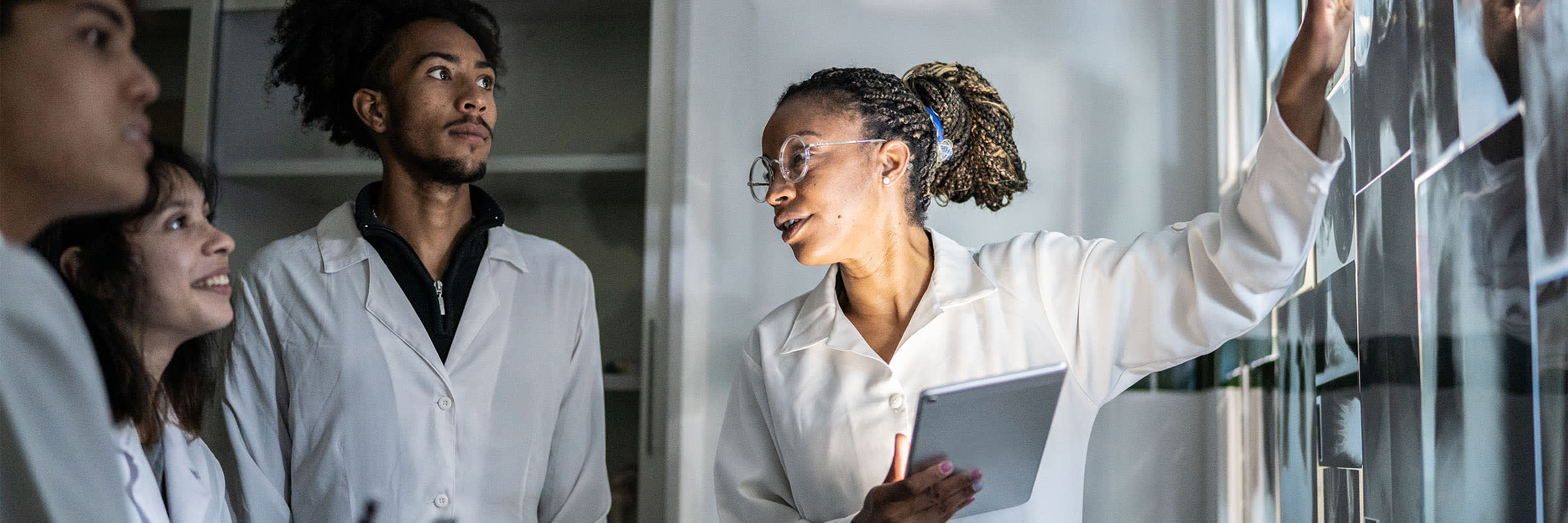
She’s not short of present-day examples, pointing first to the lab of Dr. Yasin Mamatjan. "Here in the Interior of B.C., we're short on hours for health specialists,” Dr. Airini explains. But Mamatjan's team has developed advanced AI pipelines with AI agents designed to help. One team of AI agents helps clinical decision-making for stroke patients. Another combines radiology rules with anonymized patient data to draft a personalized patient report, within strict guardrails and domain-specific knowledge. Specialists ask questions and share feedback. “Within seconds, it is possible to have a very helpful radiology report that the specialist verifies” says Dr. Airini. “The goal is to optimize specialist expertise and time, plus focused care for patients. This way of using AI will soon transform healthcare.”
Transforming waste heat into carbon reduction projects an 8-figure savings
For Milovick, the same story comes into focus through operations. Instead of simply being the infrastructure supporting the work of Mamatjan and others, the AI data centre at TRU is also proof of that work’s success. It is both a signal and a system. In his words, “a way of planting an AI flag on campus while also creating measurable academic, economic and environmental benefits.” With the AI data centre, TRU is not just building capacity, they are making it count.
Milovick sees more than a building full of servers; he sees an energy source. The facility is designed to capture its own waste heat and funnel it into either TRU’s new district energy system – already slated to come online in 2026 – or an entirely new district energy system that will serve future developments on the western side of TRU’s campus. This will reduce the fuel needed to heat the campus, potentially saving the university $18-20 million in operations and utility costs.5
“We’re turning the idea of ‘waste heat’ into ‘free heat’ that we can use,” Milovick explains. This sustainable, cost-savings approach allows TRU to host high-performance computing while also supporting the university’s goal of achieving carbon neutrality.vi While other data centres may have alternate sustainability features that better fit the needs of their community and geography, this plan aligns perfectly with the TRU vision.
Strengthening human-centred, use-inspired research, work and education
The data centre’s dual function as both support infrastructure and an example of sustainability mirrors Dr. Airini’s vision for the university. She does not treat incorporating AI as a stand-alone innovation agenda. She treats it as part of a larger institutional responsibility. AI is useful “when it helps researchers move from idea to impact more quickly, when it helps educators prepare students for the realities they will face and when it helps institutions respond to challenges that affect communities directly.”
That is why her emphasis on use-inspired work matters: it shifts the conversation away from concept and toward application. It also keeps human judgment at the centre – to give researchers, educators and professionals better tools for asking questions, analyzing evidence, and acting with more confidence and speed.
Infrastructure should create more than compute
It does not stop there. As Dr. Airini defines the purpose, so too does Milovick define the conditions that make it real. Under his stewardship, 2018 saw TRU as the first Canadian university to receive AASHE Stars Platinum – and the first to receive it a second time in 2022.7
That experience shapes his view of AI infrastructure.
For Milovick, advanced compute is not only about technical performance. It is about whether the surrounding systems create lasting value. Can the infrastructure support research and education? Can it strengthen campus operations? Can it fit into the university’s sustainability model instead of working against it? Can it help attract talent, partnerships and investment?
Both Milovick and Dr. Airini see AI and its attendant infrastructure more than a sign the campus is serious about investing in the future. They see it as something that should deliver tangible returns right now – in how students and faculty use it, but also how the university recruits, operates and plans. By saying they are “planting a flag” the point is not to signal that a data centre exists on campus. It is instead a marker of what becomes possible. It signals seriousness. It attracts proximity. It gives researchers, students and entrepreneurs a reason to see Thompson Rivers University as a place where consequential work is already happening.
“We’re turning the idea of ‘waste heat’ into ‘free heat’ that we can use.”
Matt Milovick, Vice-President of Administration and Finance
Sustainability is not a side benefit
Their view becomes most concrete in the sustainability dimension.
TRU’s April 9, 2026 construction update says work is now underway on the new data centre at 1452 McGill Road.4 Part of the Bell AI Fabric network of sovereign facilities, is designed to host AI training and inference and to provide students and faculty with access to advanced compute capabilities – but it is also designed with the capability to capture and repurpose waste heat as part of the Low-Carbon District Energy System, which began construction in August of 2025.8,9
That changes the meaning of the project.
Too many AI infrastructure stories still treat energy use, cooling and long-term cost as peripheral concerns. The work with TRU and Bell AI Fabric suggests the opposite. Those questions are central and the result reflects close consultation with the TRU and the community. If institutions are going to build serious AI capacity, they should build it in a way that produces multiple forms of value. Compute matters, but so do emissions, resilience, operating costs and the ability to integrate new capacity into the systems an institution already depends on.
That is one reason the TRU example stands out. It suggests that good AI infrastructure is not only powerful. It is also well-sited, well-integrated and accountable to a wider institutional mission, community and the environment. With thoughtful development and consultation, each community adjacent to these types of facilities can have the features that best suit their particular needs.
TRU serves as proof that these ideas are already being put into practice
The university matters in this story because it shows how these beliefs are becoming tangible realities. Working with Bell AI Fabric helps to accelerate those priorities at greater scale. TRU anticipates the project will create opportunities for collaboration with TRU researchers and students, particularly in Artificial Intelligence and Computer Science, and expects it will help drive local economic growth through employment in construction, operations, AI development and research.6
That is an important range of benefit.
Dr. Airini and Milovick have intersecting visions. TRU becomes the proof that those ideas are shaping real choices about research, student opportunity, infrastructure and sustainability. That distinction is what gives their partnership substance. It is not technology in search of purpose. It is purpose gaining the infrastructure to go further.
Sources:
- Thompson Rivers University, The Office of the President and Vice-Chancellor
- Thompson Rivers University, About the Vice-President: Matt Milovick
- TRU Community Trust, Governance
- TRU Community Trust advances data centre development (April 9, 2026)
- Sustainable Biz Canada, How Creative Energy, TRU completed a difficult district energy project (September 20, 2024)
- 2024 PSO Climate Change Accountability Report: Thompson Rivers University (May, 2025)
- STARS Report
- Increasing sovereign AI capacity: Introducing Bell AI Fabric
- TRU campus construction setting foundations for a greener future (August 29, 2025)