Staying ahead of copper theft: How to protect your network and keep your business running
Copper theft is increasing across Canada, shifting from an infrastructure issue to a serious operational risk for businesses. Thieves often cut through multiple types of infrastructure to access copper, damaging fiber and power lines as well. This can lead to immediate impacts such as outages, connectivity loss, and disruptions to critical services like 911. While some repairs are completed quickly, more complex cases can take several days to fully restore service. Driven by rising copper prices, these attacks are becoming more frequent, coordinated, and increasingly targeting a broader range of businesses.
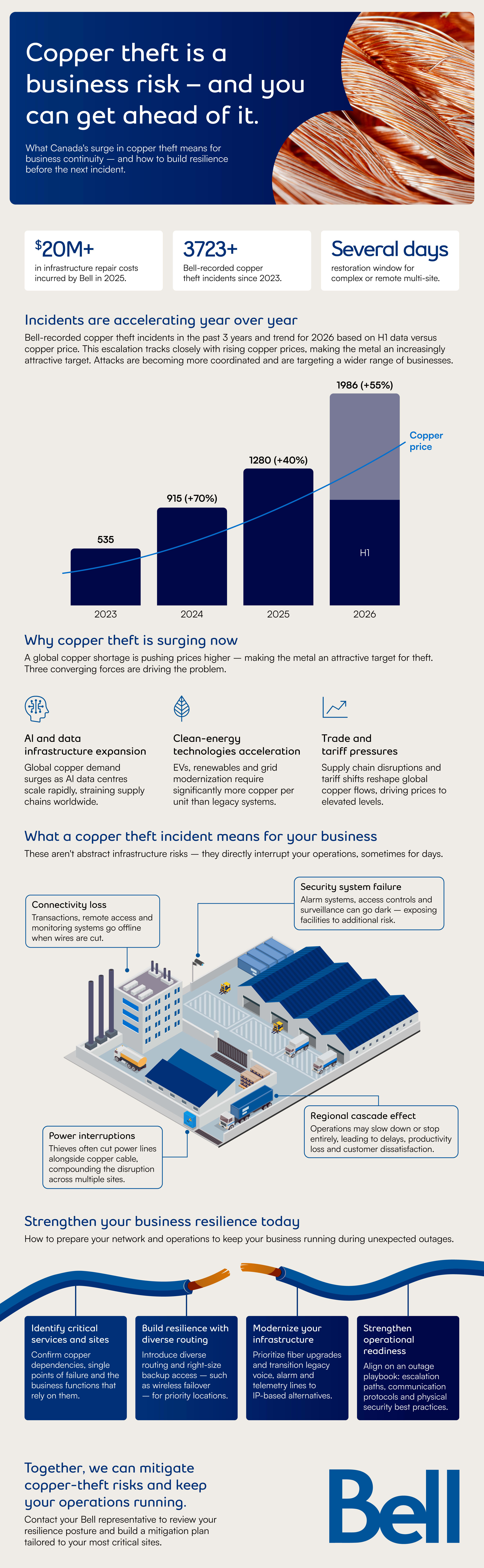
Description: Copper theft is a business risk – and you can get ahead of it
What Canada's surge in copper theft means for business continuity – and how to build resilience before the next incident.
- $20M+ in infrastructure repair costs incurred by Bell in 2025.
- 3723+ Bell-recorded copper theft incidents since 2023.
- Several days restoration window for complex or remote multi-site.
Incidents are accelerating year over year
Bell-recorded copper theft incidents in the past 3 years and trend for 2026 based on H1 data versus copper price. This escalation tracks closely with rising copper prices, making the metal an increasingly attractive target. Attacks are becoming more coordinated and are targeting a wider range of businesses.
|
Year |
Bell-recorded copper theft incidents |
Bell-recorded copper theft incidents growth percentage |
|
2023 |
535 |
- |
|
2024 |
915 |
+70% |
|
2025 |
1280 |
+40% |
|
2026 |
1986 |
+55% |
Why copper theft is surging now
A global copper shortage is pushing prices higher – making the metal an attractive target for theft. Three converging forces are driving the problem.
- Al and data infrastructure expansion: Global copper demand surges as Al data centres scale rapidly, straining supply chains worldwide.
- Clean-energy technologies acceleration: EVs, renewables and grid modernization require significantly more copper per unit than legacy systems.
- Trade and tariff pressures: Supply chain disruptions and tariff shifts reshape global copper flows, driving prices to elevated levels.
What a copper theft incident means for your business
These aren't abstract infrastructure risks – they directly interrupt your operations, sometimes for days.
- Connectivity loss: Transactions, remote access and monitoring systems go offline when wires are cut.
- Security system failure: Alarm systems, access controls and surveillance can go dark – exposing facilities to additional risk.
- Power interruptions: Thieves often cut power lines alongside copper cable, compounding the disruption across multiple sites.
- Regional cascade effect: Operations may slow down or stop entirely, leading to delays, productivity loss and customer dissatisfaction.
Strengthen your business resilience today
How to prepare your network and operations to keep your business running during unexpected outages.
- Identify critical services and sites: Confirm copper dependencies, single points of failure and the business functions that rely on them.
- Build resilience with diverse routing: Introduce diverse routing and right-size backup access - such as wireless failover - for priority locations.
- Modernize your infrastructure: Prioritize fiber upgrades and transition legacy voice, alarm and telemetry lines to IP-based alternatives.
- Strengthen operational readiness: Align on an outage playbook: escalation paths, communication protocols and physical security best practices.
Together, we can mitigate copper-theft risks and keep your operations running.
Contact your Bell representative to review your resilience posture and build a mitigation plan tailored to your most critical sites.